A while back, I was visiting my cousin when I first saw her 8-shaft floor loom. She let me sit at it and try a few throws of the shuttle. I was instantly hooked by the rhythm and the way the threads slowly built into a pattern. It looked simple but felt surprisingly precise. A few months later, I bought mine and started learning.
Weaving moves at a completely different pace from most things. In the beginning it felt slow and a bit overwhelming, but the more time I spent at the loom, the more it began to click. What I didn’t expect was how much this quiet, hands-on craft would teach me.
Sitting Down at the Loom
An 8-shaft loom is a tall wooden frame with eight horizontal shafts that hold hundreds of threads. These shafts are connected to pedals on the floor, called treadles. When I press a pedal, certain shafts rise or fall, creating a small gap called a “shed” between the threads. I then throw a shuttle (a small boat-shaped tool carrying the weft thread) through that gap from one side to the other. After that, I pull the beater forward to pack the new thread tightly against the cloth I’m making. Then I change the pedal and do it all over again.
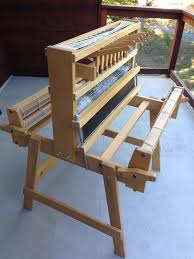
It sounds straightforward, but it takes real coordination. At first, my movements were clumsy. I would press the wrong pedal, get the rhythm wrong, or throw the shuttle too hard so it flew off the other side. Mistakes were common and sometimes costly. If I threaded a yarn incorrectly at the beginning, I might not notice until many rows later. Fixing it meant carefully pulling out threads and redoing sections by hand.
But something beautiful happens once you settle into it. The loom makes a soothing, rhythmic sound; the soft clack of the shafts, the whoosh of the shuttle, and the thump of the beater. After a while, your hands and feet begin to move almost automatically. You fall into a steady pace. The cloth grows slowly, inch by inch, right in front of you. There is no fast-forward button. You simply cannot rush the process without breaking threads or creating uneven fabric.
Some evenings I would sit for several hours without realising how much time had passed. My mind felt quieter. No notifications, no tabs, no urge to check progress every few minutes. Just the steady progression of creating something real, one careful pass at a time.
Lessons from the Loom
After several weeks of regular weaving, I noticed that my relationship with time was beginning to change. What once felt frustratingly slow started to feel peaceful. The steady rhythm of pressing the treadles, throwing the shuttle, and beating the weft slowly became satisfying instead of tedious. It was during these ordinary sessions that the real lessons started sinking in.
Real patience, I’ve learned, is not just waiting around. It is staying careful and focused even when the work feels tedious. You keep doing the same small motions correctly, row after row, even when it seems slow.
I also discovered that some things simply cannot be rushed. If I tried to weave too quickly, threads would break or the tension would go wrong and the whole piece would suffer. The loom taught me to work at its pace, not mine. Trying to force it only created more problems. This applies to many things beyond weaving. Some ideas, some projects, and even some relationships need that same level of mindfulness.
Another clear lesson is that mistakes become expensive when there is no easy undo. If I made an error in the threading at the very beginning, I might not see it until much later. Fixing it then meant undoing hours of work. Because of this, I slowly got better at thinking ahead, checking my work carefully, and doing things properly the first time.
What surprised me most was how progress works. For a long time, it feels almost invisible. You weave and weave, and the cloth grows by tiny amounts. Then one day you look up and a clear, beautiful pattern has appeared. It taught me to trust the process even when I cannot yet see the results.
There is also a deep satisfaction that comes from mastering small, repetitive actions. The simple motions that once felt awkward, gradually became smooth and almost meditative. Repeating them with care started to feel good in itself.
Above all, stepping away from constant stimulation has made my mind quieter and clearer. Hours at the loom pass without the usual mental noise. No pings, no scrolling, no jumping between tasks. Just me, the threads, and the work. That calm has begun to follow me into other aspect of my days .
Wrapping Up
Weaving hasn’t made me slower overall. In a strange way, it has made me more effective. I now take more care at the beginning of projects. I’m less tempted to rush things that need time. And I’ve become better at trusting steady, consistent effort even when results aren’t immediately visible.
What started as simple curiosity about an 8-shaft loom has quietly changed how I work and how I rest. In a world that pushes for speed and constant output, sitting at the loom reminds me that some of the best things are still built one careful thread at a time.
There is something deeply grounding about creating fabric with your own hands, watching it grow slowly, feeling its weight, and knowing every inch exists because of patient, repeated effort.
I’m still learning. But I’m grateful I took that first seat at my cousin’s loom. It taught me that patience isn’t just a virtue. In many cases, it is the most practical skill we can develop.
If there's one thing weaving reinforced for me, it's that some of the most valuable skills are also the hardest to develop in a world optimized for speed. Patience, focus, and the ability to stick with a difficult process don't come naturally. They are skills that can be cultivated. If these ideas resonate with you, here are a few books that explore similar themes from different perspectives.