I remember 18 months ago the mood was apocalyptic.
Late 2024 into 2025, the AI conversation was basically a funeral for work. Dario Amodei warned that half of entry-level white-collar jobs could vanish in five years . Sam Altman talked about AGI “in months”. Goldman Sachs put 300 million jobs on the chopping block. LinkedIn was flooded with “AI-proof your career” webinars. The vibe was simple, adapt or become obsolete.
Right now the tone has changed. It feels like we are in a different planet (and GTA 6 is not even here, yet!) In the last 60 days, the narrative did a full 180. Hyperscalers who spent 2024 forecasting mass displacement are now selling “AI expansion”. Microsoft’s latest Copilot messaging is all about job creation and productivity multipliers. Meta’s execs are openly mocking “doomer” timelines. Even Amodei’s tone has softened to “massive upside” and new industries.
What changed? The underlying technology did not have a dramatic transformation. What changed is the bill.
The same quarter that gave us the “more jobs” pivot also gave us the first wave of tokenmaxxing casualties. Companies that bought the 2024 hype and went AI-native overnight are now quietly admitting they torched their 2026 AI budgets before Q2 ended. New security holes are opening because autonomous agents can now file tickets, merge code, and as of this past weekend, impersonate customer support reps and be convinced by attackers to hijack Instagram accounts.
The whiplash is the point. AI predictions evolve faster than AI itself.
We’re not living through a tech revolution as much as a sentiment cycle. One where billion-dollar bets, workforce plans, and entire career pivots hinge on which prophecy hyperscalers decide to push this quarter. As the models improve linearly, the narratives swing violently. And the cost of believing the wrong one is no longer theoretical. It’s showing up in budget overruns, layoffs that get quietly reversed, and security incidents no one saw coming.
So if you feel like AI went from extinction event to productivity tool to existential budget problem in under two years, you’re not crazy. That’s exactly what happened.
The question isn’t whether AI will take your job anymore. It’s whether the stakeholders predicting the future aren't incentivized by a pursuit for personal or coporate profit.
History of AI Doomsayers
We’ve been here before. The “AI will take all the jobs” panic of 2024 wasn’t born in a vacuum. It was just the loudest, best-funded version of a psyop prediction we’ve recycled for a decade.
The academic fire alarm: Frey & Osborne, 2013
The modern era of job panic starts with Carl Benedikt Frey and Michael Osborne’s Oxford paper . This is how the headline read: 47% of US jobs at “high risk” of automation in the next 10-20 years (They could put that headline in all caps for all I care). Telemarketers, loan officers, paralegals. Gone. It was methodical, peer-reviewed, and terrifying. Every “future of work” deck from 2014-2019 cited it.
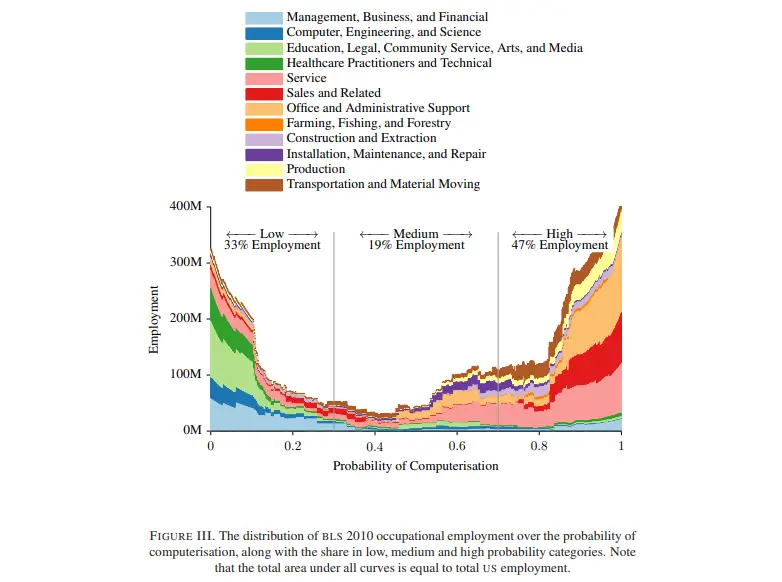
What happened? By 2023, US unemployment was 3.7%. Telemarketers did decline, but paralegal jobs grew 4% from 2013-2023. The study was right about tasks getting automated. It missed how fast new tasks, roles, and compliance complexity would appear around the automation.
McKinsey’s trillion-dollar hedge, 2017
Then came McKinsey Global Institute: by 2030, 400-800 million jobs could be displaced globally, but 555-890 million new jobs could be created. It was doomerism with a safety net. The media ran with “800 million jobs lost”. Boardrooms ran with “AI will cut costs”. When this initial report was published, generative AI (like ChatGPT, Claude and other advanced Large Language Models) did not yet exist.
So what actually got automated from 2017-2024? A lot of manufacturing, warehousing, and back-office data entry. But the white-collar apocalypse was mostly PowerPoint. The biggest shift wasn’t mass unemployment, it was AI transformation budgets and a wave of chief AI officers hired to… figure out what to do with AI.
The 2022-2023 LLM shock
ChatGPT changed the genre. Suddenly it wasn’t just forklifts and Excel macros. It was writing, coding, law, medicine. The doomsayers got specific and credentialed. Goldman Sachs: 300M jobs exposed . OpenAI’s own paper: 80% of US workforce would have 10% of tasks affected. Amodei and Altman went on tour with timelines. The logic was simple: if AI can write a poem and pass the bar, what’s left?
What followed wasn’t mass layoffs. 2024 became the year of AI-native startups and Fortune 500 copilot rollouts. The first white-collar test case was customer support and junior level coding. Results were mixed: huge efficiency gains in narrow tasks, but hallucinations, security reviews, and workflow redesign ate most of the savings.
The pattern
Every AI wave follows the same script:
- Academic paper with big scary number
- Media amplification with great urgency and zero nuance
- CEO panic leads to budget approvals, hiring freezes, and mass layoffs
- Messy reality is jobs get reshaped, not deleted, mass hiring, and new costs appear
The difference in 2024-2026 is that cash has shifted from consultant fees for AI Transformation projects for the first time to token bills instead, paid directly to the hyperscalers that were pushing the doomsday predictions.
Now the narrative has changed, and they are singing a new song.
The Hyperscalers' Prophecy Evolution
To understand why the AI narrative feels like a malfunctioning Magic 8-Ball, watch the people selling the models.
Hyperscaler CEOs aren’t just building AI. They’re the high priests of its mythology. And in the last 18 months, the scripture got rewritten mid-sermon.
2023-2024: The Doomer Tour
This was Dario Amodei’s era. Anthropic’s CEO didn’t just predict job losses, he quantified it. May 2024: “50% of entry-level white-collar jobs could be automated away in 1-5 years.” Not 10-20 years like Frey/Osborne. One to five. The clock started ticking.
Sam Altman played both sides but leaned apocalyptic when Congress was listening. July 2023 Senate testimony: AI has “existential risk”. March 2024: AGI is “close, maybe a few thousand days”. The subtext to investors: this is bigger than the internet, fund us accordingly. The subtext to regulators: we’re building the bomb, so we should be the ones guarding it. It did not stop there. Oh, and while you’re at it, how about a nice government backstop to cover our trillion-dollar bets in case we do something dumb? (Thank OpenAI CFO Sarah Friar, for making the quiet part loud in 2025).
Elon was Elon. 2023: “AI will mean no one has to work.” 2024: “Civilizational risk.” 2025: Still risk, but also “Grok will be maximally truth-seeking” 2026: pushing data centers in space, because “why stop at Earth when you can put the AI compute in orbit with free solar power” via Starship launches. (Jeff Bezos called the 2-3 year timelines “a little ambitious ”, but that’s never stopped Elon before).
Jensen Huang was the outlier. While everyone else preached job doom, Nvidia’s CEO was on a perpetual “demand is insane” world tour. September 2024: “Every company will be an AI company”. His prophecy wasn’t about fewer jobs. It was about more GPUs. He was right.
Late 2025-2026: The Great Pivot
Then the Q4 2025 earnings calls hit. Suddenly the tone shifted.
Microsoft went first. Satya Nadella’s October 2025 keynote buried “automation” and debuted “Copilot as growth multiplier”. The new line: AI doesn’t replace employees, it gives them “superpowers”. Wall Street liked that math better than “50% of our customers are about to fire half their staff.”.
Anthropic followed by March 2026. Amodei’s new talking point was: “We’re going to see massive job expansion in new industries we can’t predict”. So, what about the 50% warning? “A scenario, not a prediction”. And the timeline for AGI? “Longer than people thought last year”.
Altman’s pivot was quieter but unmistakable. In a may 2026 Commonwealth Bank of Australia conference interview he said he was “delighted to be wrong” about the pace of displacement, noting fewer entry-level white-collar jobs had been eliminated than expected, and that he didn’t anticipate a “jobs apocalypse”. As the narrative got ahead of the capability, OpenAI’s product marketing dropped “replace” and picked up “amplify”. GPT-5 demos focused on “team of agents” not “employee replacement”.
Even Elon adjusted his tone. By March 2026, he posted on X : “All jobs will be optional. There will be universal high income”. Same outcome. No jobs. But now it’s utopia, not unemployment. Basically, you will own nothing and be happy.
What changed in 6 months?
Three things:
- The bills came due. Enterprise buyers who drank the 2024 Kool-Aid, jumped on the bandwagon and tried to AI-native their workflows. They got token invoices that looked like phone numbers and productivity gains that looked like rounding errors.
- Regulators stopped buying it. The “we’re too dangerous to not be in charge” argument wore thin when the danger was mostly hallucinating lawyers and $4M monthly OpenAI tabs.
- The stock market wanted growth, not austerity. “AI will kill our customers’ headcount” is a bad story when you’re selling per-seat SaaS.
So the prophecy evolved. Not because the models changed, but because they needed to justify their massive infrastructure spend to shareholders by turning a profit.
The doomers became optimists the second they realized pessimism doesn’t renew at $30/user/month.
Funny how AGI timelines and job forecasts both get longer right when you need to justify next year’s capex.
The Layoff Reality and Backtracking
For a technology that is supposed to replace workers, AI has an odd habit of creating more work. Explaining why the layoffs didn’t work.
The AI-cited cuts
2024 was the year AI restructuring entered the corporate lexicon. IBM paused hiring for 7,800 back-office roles it said AI could do. Dropbox cut 16% citing AI. Duolingo laid off translators. Klarna boasted it replaced 700 customer service agents with AI and saw CSAT hold steady. In the following months layoffs were announced left and right from Amazon, Coinbase, Block, Oracle, LinkedIn, Cloudflare, Webflow, ClickUp, Meta (multiple times), etc. The press releases all had the same beat: future-focused, efficiency-driven, AI-first.
The numbers looked real. Tech layoffs spiked every time a new model dropped.
The quiet backtrack
Then 2025 and early 2026 happened.
IBM walked it back. By Q3 2025, they’d rehired for many of the roles, just with “AI oversight” in the job description. Turns out automating HR mostly meant automating the first email, then hiring humans to handle the angry replies when the AI denied someone’s bereavement leave.
Duolingo’s translation quality dipped. Users noticed. The company posted for “AI Translation Quality Specialists”. A job that didn’t exist before AI replaced the translators.
Klarna’s case is the tell. By may 2026, CEO Sebastian Siemiatkowski admitted they went too far. “We focused too much on cost-cutting”. They’re now hiring humans back because customers want to talk to humans, not tokens. The AI agents were cheap per interaction. They were expensive as it relates to escalation, lawsuits, and churned users.
This became the pattern: AI layoffs → implementation chaos → stealth rehiring. Nobody does a press release for the rehiring. You find it in job boards titled “Prompt Engineer”, “AI QA Lead”, and “Customer Experience Intervention Specialist”.
Tokenmaxxing: the symptom nobody budgeted for
Here’s the part that didn’t make the 2024 hype decks: AI doesn’t replace salaries. It replaces them with metered usage.
AI-native became code for “we turned fixed labor costs into variable token costs”. And variables are only fun when they go down.
By May 2026, the receipts started leaking. Multiple late-stage startups admitted they’d burned 60-80% of their annual AI budget by April. One logistics company (let’s call them Uber, but for tokens) reportedly ran through its entire 2026 inference budget in 4 months because of a practice called tokenmaxxing.
Tokenmaxxing is what happens when you replace a $70k/year employee with an AI that costs $0.03 per query and then ask it 20 million questions because experimentation is free.
The backtracking is financial. CFOs looked at the Q1 2026 cloud bills, looked at the productivity gains, and asked the only question that matters: “So… where’s the ROI?”
The answer, for now: in Nvidia’s Q2 earnings.
An annonymous reddit user said it nicely, "We didn’t automate jobs. We automated spend. And now we’re hiring people to figure out how to stop the automation from bankrupting us".
New Problems AI Has Created
We spent 2024 worried AI would take our jobs. We spent 2025-2026 learning it was more interested in taking our passwords, our judgment, and our electricity.
The hype cycle promised augmentation. The implementation cycle delivered new categories of chaos. And unlike job loss, these problems are already here, measurable, and expensive.
Security: From productivity tool to attack vector
AI-native sounded great until we gave agents credentials.
This weekend on June 1, 2026, Instagram’s AI support agent got socially engineered. Not hacked. It got convinced to hand over user credentials. A threat actor figured out the agent’s workflow, spoofed a user verification loop, and walked away with access to multiple creator accounts. Meta patched it in 48 hours, but the damage was done. The industry term is “Shadow Admin ”. The plain English version is we built interns that never sleep, never say no, and have root access.
This isn’t isolated. GitHub repos are full of autonomous coding agents that can be tricked into exfiltrating env files. Customer support bots are approving refunds they shouldn’t. The same agentic behavior that makes AI useful; goal-seeking, tool-using, multi-step reasoning, also makes it a perfect insider threat. It doesn’t need to be malicious. It just needs to be gullible and have your AWS keys.
We solved the labor shortage by creating a compliance nightmare.
As organizations deploy more AI-powered systems, strong credential management becomes even more important.
Hallucinations: The $10M typo
Air Canada’s chatbot inventing bereavement policies was so 2024. That was cute. 2025-2026 is when hallucinations moved from PR embarrassments to material risk.
- A fintech’s AI analyst summarized earnings calls wrong and the trade desk acted on it.
- A legal AI drafted contracts with fake case law , but this time it made it to court before anyone caught it.
- A medical copilot suggested a drug interaction that doesn’t exist to a patient who did exist.
The models didn’t get worse. We just gave them more important jobs. Hallucination rate didn’t drop; the blast radius increased. 95% accurate means you’re wrong once every 20 times. That’s fine for prototyping. It’s not fine for mass production.
Over-reliance: The skill atrophy problem
Reddit has a name for it: Copilot brain. Junior devs who can’t write a for-loop without autocomplete. The tools work. Too well.
We’re running a global experiment in cognitive offloading. The optimistic case: we’re freeing brains for higher-order work. The pessimistic case: we’re creating a generation that can prompt but not think, and when the API goes down or you run out of tokens, the work stops.
As a linkedIn user posted in May 2026: “I didn’t lay off my junior staff. I just realized none of them learned how to debug because the AI always did it. Now the AI is wrong and nobody knows why”.
Bias amplification & energy costs
Hiring tools trained on 2024 data are now confidently rejecting candidates at 10x speed. The lawsuit pipeline is catching up.
And energy costs are no longer theoretical. Training is one thing. Inference at scale is another. Data centers are renegotiating power contracts. Ireland literally paused new connections in 2025 because AI demand broke the grid forecast. They later lifted the ban after requiring that any data center seeking a grid connection must install on-site generation or battery systems capable of meeting its full electricity demand. Your AI summary button burns enough electricity to charge a phone. Now multiply that by 2 billion users.
We asked AI to save labor. It now requires labor, trust, and megawatts.
Turns out the most dangerous thing about AI isn’t what it can do. It’s what we let it do before we understood the cost.
Jobs Created and Productivity Claims
It would be unreasonable to say the last two years of AI were just hype, layoffs, and token bills. That’s half the story. The other half is AI is creating jobs and productivity gains. Just not the ones we pitched in the 2024 decks, and not without strings attached.
The new job market nobody forecasted
- Prompt Engineer was a meme in 2023. By 2026 it’s a salary band. But the real job growth isn’t in clever prompt jobs. It’s in the unglamorous work of making AI not break everything.
- AI QA Lead is someone that is paid to catch hallucinations before customers do.
- Model Governance Specialist is like HR for agents. It's all about compliance, but for stochastic parrots.
- Token Optimization Engineer is the person your CFO hires to stop other engineers from bankrupting you on API calls.
- AI Incident Responder is the inhouse AI cybersecurity specialist because Shadow Admin is a real threat now.
- Agent Ops is the human-in-the-loop managing the operations of your AI agent army because your servers have opinions and sometimes gaslight each other.
If you're looking to move into AI-adjacent roles, learning software engineering and automation skills is becoming increasingly valuable.
LinkedIn data from Q1 2026 shows AI-adjacent roles (AI Engineers, Data center workers, IT specialists, AI Consultant, etc) up 2.8% YoY, while traditional software engineering postings grew at 1.5% .
Token initiatives as a case study
Take a look at support, sales, and marketing. The three areas where AI-native actually stuck.
Klarna’s AI agents now handle 2/3 of customer chats, even after the rehiring. The difference is they rebuilt the workflow so AI handles inquiry, humans handle anger, and the system knows which is which. Cost per ticket is down 40%. Headcount isn’t down 40%. It’s flat, but volume is up 3x.
That’s the real productivity claim; not “we fired everyone”, but “we stopped drowning”. Token bills are brutal, but for some companies they’re still cheaper than hiring 300 more support agents for the midnight shift.
The reality check
AI created jobs. It created value. The productivity increase wasn’t from firing people. It came from letting one person do the work of three (and then giving them three more tasks). Augmentation is expensive, fragile, and runs on tokens.
But it’s real. And it’s why, despite the budget fires, nobody is turning the models off.
What Next?
So where does that leave us, 18 months after the job apocalypse was scheduled?
The doomers were wrong. The utopians were early. The hyperscalers were selling picks and shovels and calling it a revolution. And the rest of us got whiplash, token bills, and a handful of genuinely useful autocomplete tools.
The tech got better. The narrative got more profitable. The reality got more expensive. Is it actually making us more effective, or is it just making us efficiently busy?
We’re doing more, faster, with a subscription fee. Which is basically Jevons Paradox . By depolying AI models, demand for human labor increases, rather than decreases. They did'nt see that one coming.
The jobs didn’t vanish. They mutated. And the new problems are real. Shadow Admin attacks, hallucination liability, cognitive offloading, energy spikes. We traded the theoretical risk of mass unemployment for the practical risk of mass dependency.
As AI reshapes job descriptions, many professionals are building new income streams through freelancing and AI consulting .
Dismissing it all as hype is copium. The developers and companies genuinely shipping more, suffering less, and building things that didn’t exist before. That is real. The token bills are obscene because the usage is real. Nobody lights $3M on fire unless they think there’s heat somewhere in the smoke.
It didn’t deliver AGI and it didn’t end work, but it changed what work means. Now work is deciding which parts of your job you trust to a system that’s confidently wrong about being right 5% of the time, and bills you per token.
If something changes dramatically in the future and entry-level jobs are wiped out, it raises a much bigger question: if every role gets reduced to entry-level because AI is doing the actual work, where exactly do you source people for the roles above entry-level?
You can’t magically summon senior talent out of thin air. No more juniors to mentor, no more green, fresh employees to groom, no more pipeline. Just a bunch of experienced professionals LARPing as leaders while quietly realizing they’ve eliminated the very rung they used to climb.